Research Project · Est. 2026
ATTA Investment
Exploring the world of investing, powered by AI agents.
Designed to research opportunities, challenge investment assumptions and determine when investing may not be the right decision.
Explore the project01 — Founder
About the Founder
Nicola Azzano
Founder and Developer of ATTA Investment
Nicola Azzano developed ATTA Investment during the summer and autumn of 2026 as a project combining his interests in business, financial markets and artificial intelligence.
ATTA began as a personal experiment, but developed through constant testing and restructuring. Prompts were rewritten, workflows were changed and stages were added or removed as problems appeared. After the first complete version was built, ATTA was also tested by other users, allowing the project to move beyond its original use and showing how the system could help others approach investment research in a more structured way.
02 — Context
The Problem
“The problem was never finding more information. It was deciding what to do with it.”
Financial markets generate an enormous amount of data, news and analysis every day. The real challenge is combining that information into one clear decision while considering the investor’s capital, time horizon and risk tolerance.
After hours of research, it can become easy to feel that something must be bought simply to justify the effort. ATTA removes that pressure by analysing the market against the user’s parameters and recommending a move only when the conditions justify it. Sometimes that move is to hold cash.
03 — Architecture
How ATTA Works
ATTA does not rely on a single AI prompt. The final decision is built through a sequence of specialised research, analysis and review stages.
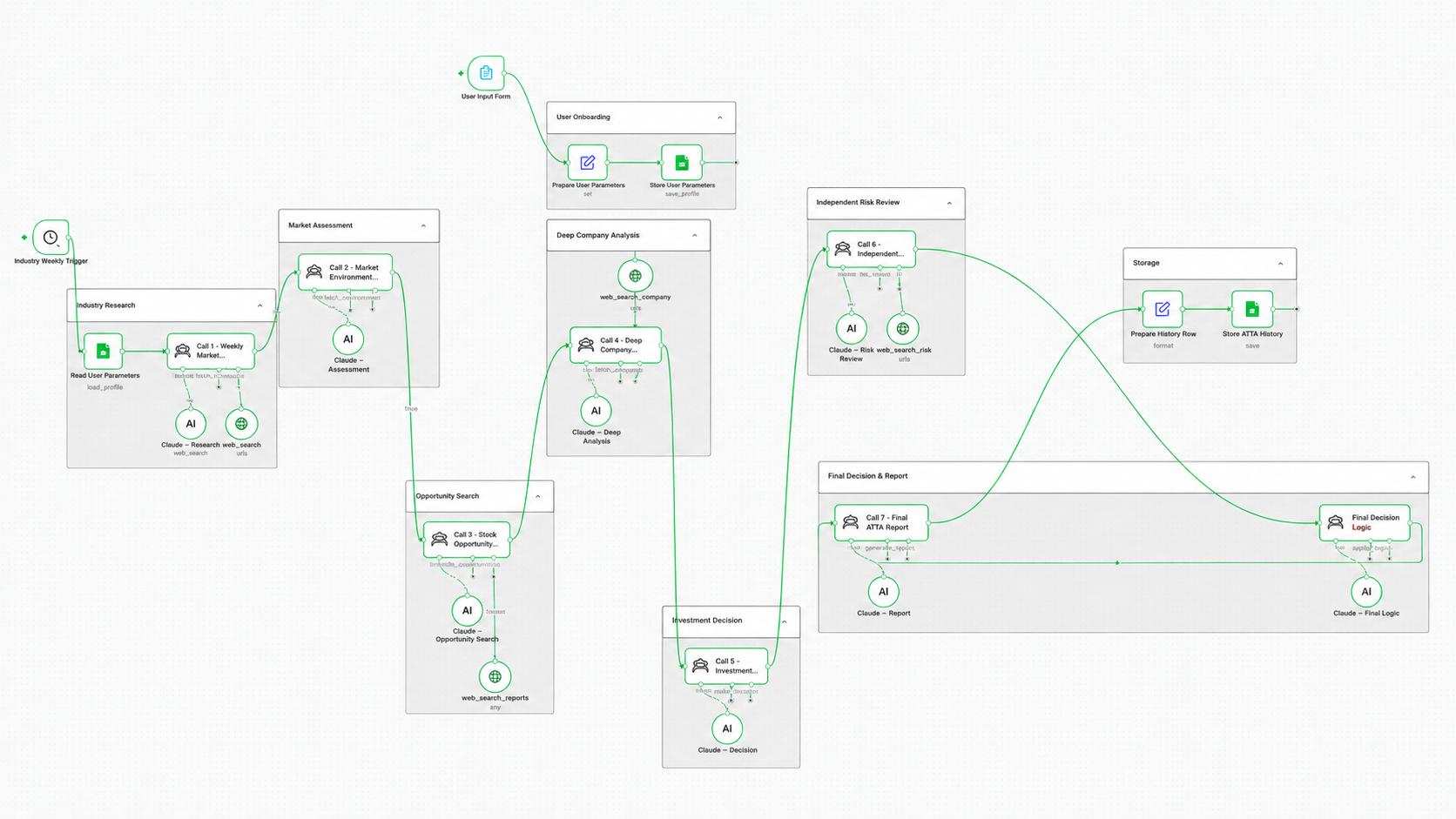
Call 1
Market Research
ATTA scans major markets across the US, Europe and Asia to understand what is happening and where opportunities may exist.
Call 2
Market Environment
The system evaluates the wider economic and market environment before looking at individual companies.
Call 3
Opportunity Search
ATTA screens roughly 10 to 15 companies and narrows them down to a smaller group of around five finalists worth deeper research.
Call 4
Deep Company Analysis
Each finalist is analysed individually using company fundamentals, recent developments, risks and other relevant information.
Call 4B
Finalist Ranking
The surviving companies are compared against each other and ranked before an investment decision is made.
Call 5
Investment Decision
ATTA combines the research with the user’s capital, risk tolerance and investment horizon. It then decides whether an investment is justified or whether the result should be HOLD CASH.
Call 6
Independent Risk Review
A separate review challenges the proposed decision and searches specifically for risks or weaknesses that earlier stages may have missed. If the proposed investment fails this review, ATTA can reject it.
Call 7
Final Report
The complete analysis is turned into a final report explaining what ATTA found, what the risks are and what action the system suggests.
04 — Process
Building ATTA
ATTA was not built in one attempt. It evolved through research, testing, technical failures, prompt redesign and repeated restructuring.
Initial Concept
ATTA began as a much more ambitious idea. The original concept included not only market research and investment recommendations, but also a paper trading system designed to test the strategy before any real investment decision was made.
Initial Research
Before building anything, research started around the fundamentals of the system: how a stock should be valued, which global markets mattered most, what information an investment decision should consider, and which platform could support the project.
Designing the Paper Trading System
Development then moved towards the paper trading side of ATTA, including exploring how Python could be used to simulate and track investment performance. It soon became clear that time was becoming a major constraint, and paper trading was removed from ATTA 1.0 so the core investment research agent could be completed first.
Prompt Development
The first prompts were written and ATTA started to become a real working system rather than just an idea. Each call was given a specific role in the research and decision process, and the workflow began to take shape.
The Runtime Problem
Early versions repeatedly failed before reaching the final report. The issue was traced to a five minute execution limit inside the n8n workflow. Removing this restriction allowed ATTA to run for longer, but the workflow then reached around ten minutes before the infrastructure struggled to support the amount of processing required.
Restructuring the Agent
The problem was not only technical. Call 4 was asking for too much deep analysis at once, making the workflow unnecessarily heavy. The prompts were reorganised, responsibilities were redistributed between calls, and the overall structure became more efficient.
ATTA 1.3: First Complete Report
After several iterations, ATTA 1.3 successfully completed the full workflow and produced its first real detailed investment report. This marked the point where ATTA moved from a developing system into a working prototype capable of analysing market conditions, evaluating opportunities and reaching a final investment decision.
ATTA External Testing
Further personal testing was paused because repeated runs over the same short period were expensive and would provide limited new evidence under similar market conditions. Meaningful testing required time and changing market conditions.
Over the following weeks, ATTA was tested by other users under different market conditions. Their feedback showed that the system could consolidate research that would normally take hours into one structured process. The HOLD CASH outcome was particularly valued because it removed the pressure to invest simply because research had already been completed.
05 — Output
What ATTA Produces
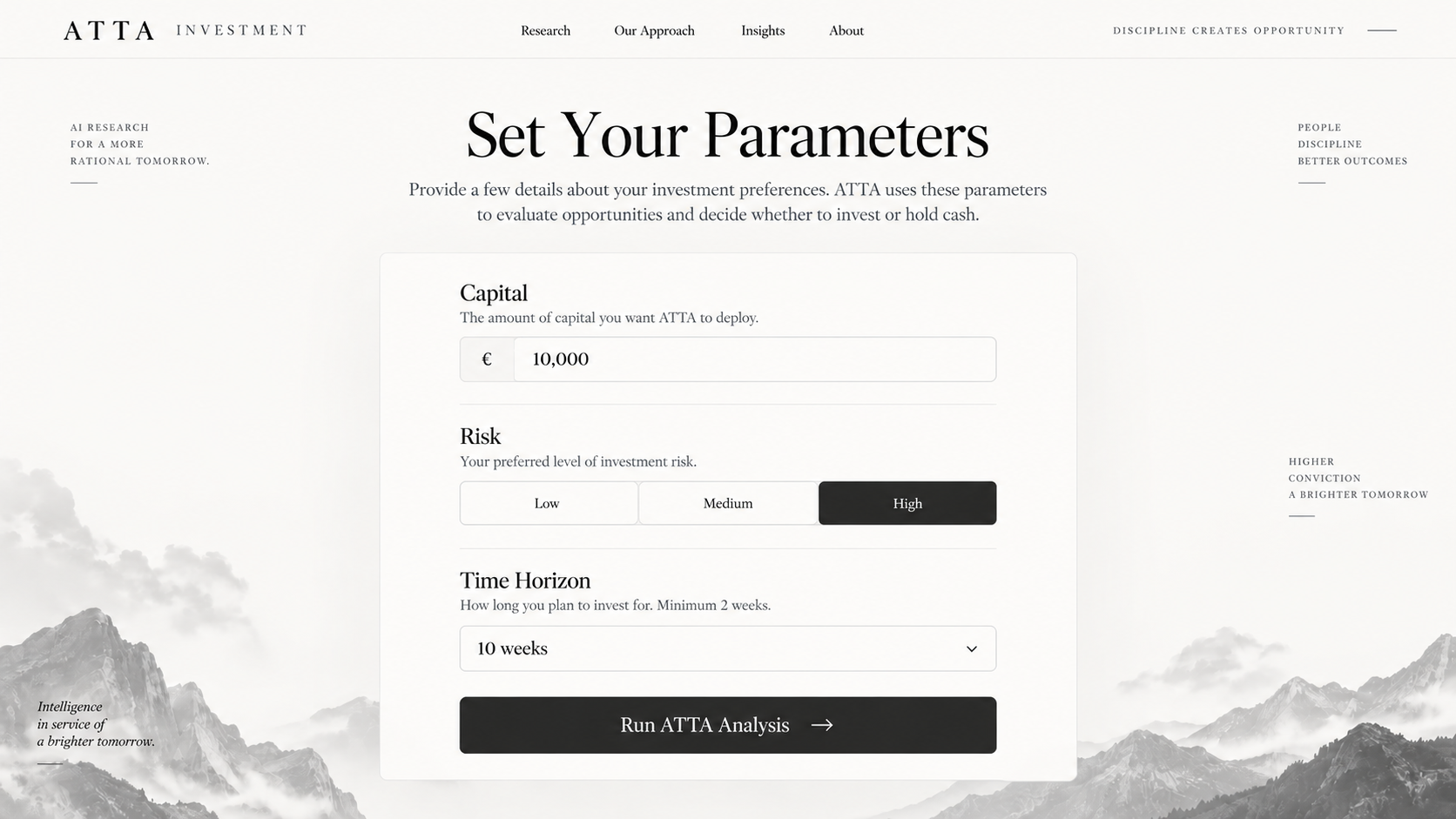
“ATTA begins with three investor specific parameters: capital, risk tolerance and time horizon. It combines these inputs with current market research to produce a final investment report.”
“The final result does not have to be an investment. If the available opportunities do not justify the risk, ATTA can conclude that the appropriate decision is to hold cash.”
01
User Parameters
02
ATTA Output
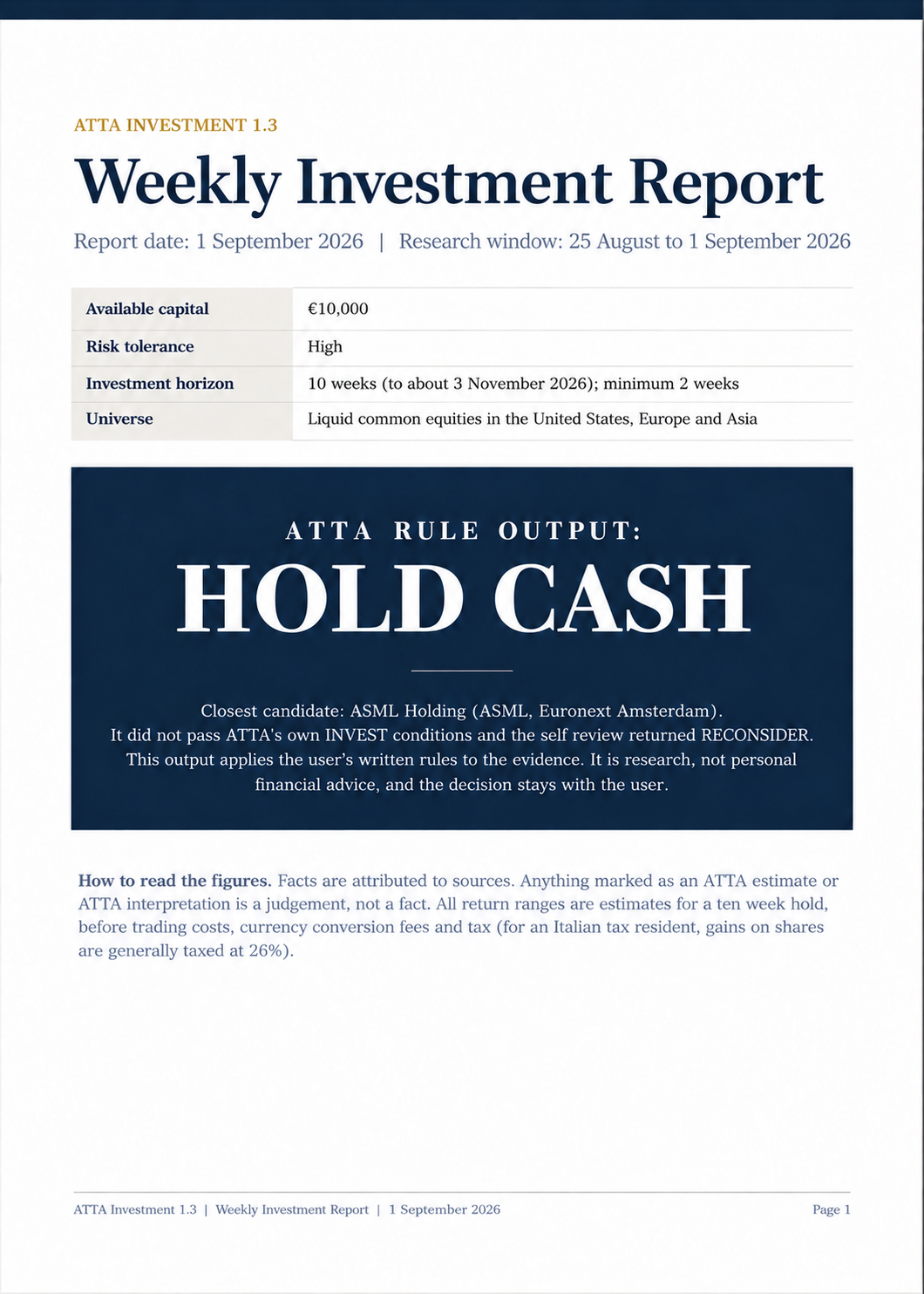
“The purpose of ATTA was not to always find something to buy. It was to reach a reasoned decision based on the evidence available.”
06 — Reflection
From Testing to a Business Model
“External testing also created a simple way to test whether ATTA could generate value beyond my own use. Users provided their capital, risk tolerance and investment horizon, and ATTA produced its decision without any upfront fee.”
“When ATTA recommended an investment, it also suggested a holding period based on the user’s original time horizon. ATTA was only compensated when the strategy generated a profit. If the investment lost money, no payment was required and the outcome became feedback for the system. If ATTA recommended HOLD CASH, no payment was required either.”
“External use recovered ATTA’s initial development costs and showed that the project could support a potential business model. The performance based pricing structure also proved useful during testing, as ATTA only generated revenue when its users achieved a positive result.”
07 — Contact
Contact
For questions about ATTA, the development process, external testing or the project itself, feel free to get in touch.
- groweaisme@gmail.com
- Nicola Azzano